All published articles of this journal are available on ScienceDirect.

Modifiable Behavioral Determinants of Myopia Occurrence and Severity among Primary Schoolchildren in Vietnam

Abstract
Introduction
Childhood myopia has become a major public health concern worldwide. This study investigated the prevalence, severity, and behavioral factors associated with myopia among primary schoolchildren in Nghe An province, Vietnam.
Methods
A school-based cross-sectional study was conducted among 9,498 boys and girls aged 6-10 years from 10 primary schools. Distance visual acuity screening was followed by refractive assessment using autorefractometry and retinoscopy. Behavioral and familial information was collected using structured questionnaires. Multivariable and ordered logistic regression models accounting for school clustering were used to identify factors associated with myopia and its severity.
Results
The prevalence of myopia was 20.7% (1,966/9,498); 68.9%, 25.1%, and 6.0% had low, moderate, and high myopia, respectively. A near-work distance ≥30 cm was associated with lower odds of myopia (adjusted odds ratio [aOR] 0.22, 95% CI 0.19-0.26), whereas extra study time >2 hours/day (aOR 1.63, 95% CI 1.32-2.00) and screen exposure ≥2 hours/day (aOR 1.44, 95% CI 1.26-1.65) increased the risk. Outdoor activity ≥3 hours/day was protective (aOR 0.48, 95% CI 0.40-0.57). The same behavioral factors were also independently associated with greater myopia severity.
Discussion
These findings support previous evidence that modifiable lifestyle behaviors influence both myopia occurrence and severity. However, causal relationships cannot be inferred because of the cross-sectional design.
Conclusion
Reading distance, extra study time, screen exposure, and outdoor activity were independently associated with myopia occurrence and severity. Promoting healthy visual habits and increasing outdoor activity should be prioritized in school-based myopia prevention programs.
1. INTRODUCTION
Myopia among children has increased rapidly over recent decades worldwide. Although this trend has been particularly pronounced in Asia, rising prevalence has been documented across all continents. A recent systematic review and meta-analysis including 276 studies from 50 countries reported that the global prevalence of myopia increased from 24.3% in 1990 to 35.8% in 2023 and is projected to reach 36.6% by 2040 and 39.8% by 2050. Some of the highest prevalence rates worldwide have been reported in East and Southeast Asia, where myopia has become a major public health concern among school-aged children and adolescents [1-5]. Importantly, the prevalence of high myopia has also increased worldwide. Beyond its impact on visual function and educational performance, high myopia is particularly concerning because of its association with sight-threatening complications later in life, including myopic maculopathy, retinal detachment, glaucoma, and irreversible visual impairment [6-8].
A substantial body of epidemiologic evidence has identified near-work activities, screen exposure, reduced outdoor time, sedentary behavior, and other lifestyle-related factors as important behavioral correlates of childhood myopia [9-11]. Recent systematic reviews and meta-analyses have further demonstrated dose-response relationships between screen exposure, outdoor activity, physical activity, and myopia risk, highlighting the importance of modifiable behavioral factors in myopia prevention and control [12-15].
Childhood myopia has been increasingly reported in Vietnam in recent years. Studies from different regions of the country have shown that the prevalence may range from about 17% to more than 40%. In general, the prevalence tends to increase with age and is usually higher in urban areas than in rural areas [16-18]. Although previous studies have provided useful information, many of them were conducted mainly in urban schools and included relatively small samples. In addition, most studies focused on myopia prevalence, while less attention was given to myopia severity or possible dose-response relationships with behavioral factors.
Nghe An province, the largest province in Vietnam by land area, encompasses a wide range of geographic zones, including mountainous, midland, lowland, and coastal regions. This geographic and socioeconomic diversity provides a unique natural setting in which to examine childhood myopia across heterogeneous environmental exposures, lifestyle patterns, and educational contexts within a single population. To date, no large-scale multi-regional study in Vietnam has jointly evaluated myopia occurrence and severity while simultaneously modeling modifiable behavioral factors, dose-response relationships, and intra-familial risk patterns.
The present study was therefore designed to address these gaps by investigating the prevalence, severity distribution, and modifiable behavioral determinants of myopia among primary schoolchildren aged 6-10 years in Nghe An province, Vietnam. Leveraging a large multi-regional school-based sample, we jointly modeled both myopia occurrence and severity, examined dose-response and threshold effects for key behaviors (near-work distance, extra study time, screen exposure, and outdoor activity), and explicitly compared the relative contributions of sibling and parental myopia as proxies for combined genetic-environmental risk. In addition, we estimated adjusted predicted probabilities to provide an intuitive, policy-relevant characterization of how behavioral modifications may translate into changes in myopia risk and severity.
By extending beyond conventional prevalence estimates, this study provides novel epidemiologic evidence on how modifiable behaviors and intra-familial risk patterns jointly shape both the occurrence and severity of childhood myopia in a heterogeneous LMIC setting. These findings are intended to inform operationalizable, behavior-focused, and family-based strategies for myopia prevention and control in primary school populations.
2. MATERIALS AND METHODS
2.1. Subjects and Sampling Methods
Nghe An is the largest province in Vietnam by land area, encompassing diverse geographical zones, including coastal plains, low mountainous regions, river-adjacent midland areas, and high mountainous regions. This geographic diversity provides a heterogeneous environmental context for investigating childhood myopia.
A school-based cross-sectional survey was conducted in Nghe An Province, Vietnam. Data were collected between February and May 2023 through a provincial vision screening program involving primary school children. The collected dataset was subsequently cleaned, validated, and analyzed for research purposes in 2024. Ten primary schools were selected to represent the major geographic regions of the province, including lowland-coastal and mountainous areas. School selection was performed using a stratified random sampling approach, with strata defined according to geographic region. The number of schools selected from each stratum was proportional to the regional population size and school distribution. This sampling strategy was designed to minimize selection bias and enhance the representativeness and generalizability of the study findings.
2.1.1. Sample Size Calculation
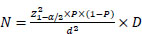
The required sample size was calculated using Eq. (1) for estimating a population proportion:
 (1)
(1)
where N is the minimum required sample size, Z is the standard normal deviate corresponding to a 95% confidence level (1.96); P=0.20 is the expected prevalence of myopia based on previous studies in Vietnamese schoolchildren, d=0.03 is the desired absolute precision, and D=1.5 is the design effect used to account for cluster sampling at the school level. Based on Eq. (1), the minimum required sample size was calculated to be approximately 1,025 children. To ensure adequate representation across different geographic regions and improve the precision and generalizability of the study findings, all eligible children in the selected schools were invited to participate. Consequently, the final analytical sample comprised 9,498 children. The sample size estimation was based on the standard formula for estimating a population proportion and was consistent with the methodology used in previous school-based epidemiological studies of refractive error [19, 20].
A cluster sampling strategy was employed, with each primary school considered as a sampling cluster. All eligible children enrolled in the selected schools were invited to participate in the study.
2.1.2. Eligibility Criteria
Inclusion criteria were as follows:
- Children aged 6-10 years;
- Ability to achieve a best-corrected distance visual acuity of 20/32 (Snellen equivalent) or better in both eyes;
- Astigmatism ≤2.00 diopters;
- Absence of ocular abnormalities on clinical examination.
Exclusion criteria included:
- Parental refusal to provide informed consent;
- History of contact lens wear, use of bifocal or multifocal lenses, or previous ocular surgery.
2.1.3. Final Study Sample
Of the children screened. 9,498 participants met the eligibility criteria and were included in the final analysis.
Because participants were sampled within schools, all subsequent analyses accounted for within-school clustering to obtain valid standard errors and population-level inferences. Sex was recorded as male or female according to school records. Both boys and girls were eligible for inclusion, and no participants were excluded based on sex. Sex was prespecified as a covariate and included in all multivariable regression models. The Sex and Gender Equity in Research (SAGER) Guidelines were followed by the authors. This study was reported in accordance with the Strengthening the Reporting of Observational Studies in Epidemiology (STROBE) guidelines.
2.2. Ophthalmic Examination and Outcome Definitions
All participating children underwent a standardized ophthalmic examination conducted by trained ophthalmologists and optometrists following the Refractive Error Study in Children (RESC) protocol. Distance visual acuity was measured monocularly using a standard Snellen chart at 5 meters, with habitual correction if available. Children with uncorrected distance visual acuity worse than 20/32 in either eye underwent refractive assessment. Objective refraction was initially measured using an automated autorefractor/keratometer (ACCUREF-K 9001, Shin Nippon, Japan) under standardized examination conditions. Streak retinoscopy was subsequently performed by trained ophthalmologists to verify the autorefractor measurements and resolve discrepancies or inconsistent readings. All examiners underwent standardized training before data collection to ensure uniform examination procedures. Subjective refinement was performed when feasible to determine the final refractive status.
The Spherical Equivalent Refraction (SER) was calculated as the spherical power plus half of the cylindrical power and was used for subsequent analyses. Myopia was defined as an SER of ≤ −0.50 diopters (D) in either eye. Myopia severity was further classified into three ordered categories based on SER in the more myopic eye, consistent with commonly used epidemiological [21-23].
- Low myopia: SER > −3.00 D and ≤ −0.50 D
- Moderate myopia: SER > −6.00 D and ≤ −3.00 D
- High myopia: SER ≤ −6.00 D
For analyses involving myopia severity, these categories were treated as an ordinal outcome variable.
2.3. Assessment of Behavioral and Familial Factors
Behavioral and familial information was collected using a structured questionnaire administered to parents or guardians. The questionnaire captured data on children’s near-work activities, screen-based device use, outdoor activities, and family history of myopia.
Near-work activities included extra study time, homework, and self-study after regular school hours. In Vietnam, primary school children usually spend about four hours per day in regular classroom learning. For this reason, “extra study time” referred to study activities that took place after school. Daily extra study time was grouped into three categories: no extra study time, ≤2 hours per day, and >2 hours per day. Reading distance during near work or device use was also recorded and classified into three groups: <20 cm, 20-<30 cm, and ≥30 cm.
Screen-based device exposure included smartphones, tablets, computers, and television. Total daily screen time was dichotomized as <2 hours/day and ≥2 hours/day.
Outdoor activity was assessed based on average daily time spent outdoors and categorized into four groups: <1 hour/day, 1-<2 hours/day, 2-<3 hours/day, and ≥3 hours/day.
Family history of myopia was assessed separately for parents and siblings. Parental myopia was categorized as present if either parent was reported to have myopia, while sibling myopia was defined as the presence of myopia in at least one sibling. All examinations were performed by trained ophthalmologists and optometrists using standardized protocols, and inter-observer agreement was periodically assessed during fieldwork to ensure measurement consistency.
2.4. Statistical Analysis
We analyzed the data using Stata version 17.0. Descriptive statistics were first used to describe demographic characteristics, behavioral factors, and the distribution of myopia in the sample.
The prevalence of myopia was calculated overall and stratified by age, sex, geographic region, and behavioral exposures. Associations between myopia occurrence (yes/no) and potential risk factors were first examined using univariable logistic regression to estimate crude odds ratios (ORs) and 95% confidence intervals (CIs). Variables with established clinical relevance or statistical significance in univariable analyses were subsequently entered into multivariable logistic regression models to estimate adjusted ORs (aORs).
Because participants were sampled within schools using a cluster sampling design, all regression models were fitted with robust sandwich estimators to account for within-school clustering and to obtain cluster-robust standard errors. This approach was applied consistently across all binary and ordinal outcome models.
Ordered logistic regression was used to analyze factors related to myopia severity. Myopia severity (low, moderate, and high myopia) was treated as an ordinal outcome. The proportional odds assumption was tested using the Brant test and found acceptable for the final models. Age, sex, geographic region, near-work behaviors, screen exposure, outdoor activity, extra study time, and family history of myopia were included as covariates.
Possible interactions between behavioral factors were also examined. We added interaction terms to the multivariable models, including outdoor time × screen exposure, outdoor time × near-work distance, and outdoor time × sibling myopia. The interaction effects were tested using likelihood ratio tests and Wald tests. Only interactions with statistical support were retained in the final models.
Dose-response relationships between behavioral exposures and myopia outcomes were examined by modeling ordinal or categorical exposure variables as continuous trend terms and by estimating category-specific adjusted ORs. In addition, potential behavioral threshold effects, particularly for outdoor time and near-work distance, were assessed by comparing adjacent exposure categories and inspecting non-linear patterns in predicted risk.
Adjusted predicted probabilities of myopia occurrence and myopia severity across categories of outdoor time, near-work distance, and screen exposure were estimated using post-estimation marginal effects (margins). These probabilities were visualized using margins plots with 95% confidence intervals to provide an intuitive and policy-relevant characterization of how incremental behavioral changes may translate into differences in myopia risk and severity.
All multivariable models were adjusted for age, sex, geographic region, near-work behaviors, extra study time, screen exposure, outdoor activity, and family history of myopia. Multicollinearity was assessed using variance inflation factors (VIFs), and no evidence of problematic collinearity was detected. Missing data were minimal (<5% for all variables) and were handled using complete-case analysis.
All statistical tests were two-sided, and a p-value <0.05 was considered statistically significant.
2.5. Ethics Approval and Consent to Participate
This study was conducted in accordance with the principles of the Declaration of Helsinki. Administrative authorization to conduct school-based vision screening activities was obtained from the Nghe An Provincial Department of Education and Training (No. 364/SGD, dated February 27, 2023). Ethical approval for the present research, including the study protocol and analysis of the collected data, was subsequently obtained from the Ethics Committee of the University of Medicine and Pharmacy at Ho Chi Minh City, Vietnam (Approval No. 523/HĐĐĐ-ĐHYD, dated March 27, 2024). The administrative approval authorized implementation of the school-based screening program, whereas the ethics approval covered the subsequent research use and analysis of the collected data.
Written informed consent was obtained from the parents or legal guardians of all participating children after detailed explanations of the study objectives, procedures, potential risks, and benefits were provided. In addition, assent was obtained from the children in an age-appropriate manner, with verbal agreement recorded in the presence of a teacher and a member of the study team.
Participants and their families were informed that participation was voluntary and that they could withdraw from the study at any time without any consequence.
The Sex and Gender Equity in Research (SAGER) Guidelines were followed by the authors.
3. RESULTS
3.1. Study Population and Overall Prevalence of Myopia
A total of 9,498 primary school children aged 6-10 years were included in the final analysis. Among them, 1,966 children were diagnosed with myopia, yielding an overall prevalence of 20.7% (Table 1). Regarding myopia severity, low myopia accounted for the largest proportion (68.9%), followed by moderate myopia (25.1%), while high myopia represented 6.0% of all myopic cases.
Prevalence and severity distribution of myopia according to age, sex, and geographic region among primary schoolchildren aged 6-10 years in Nghe An province, Vietnam.
| Characteristics | Total Children (n) | Myopic Children (n) | Prevalence (%) |
|---|---|---|---|
| Overall | 9498 | 1966 | 20.7 |
| Myopia severity* | - | - | - |
| Low myopia | — | 1354 | 68.9 |
| Moderate myopia | — | 493 | 25.1 |
| High myopia | — | 119 | 6.0 |
| Age (grade-based) | - | - | - |
| 6 | 1794 | 265 | 14.8 |
| 7 | 1983 | 374 | 18.9 |
| 8 | 1761 | 328 | 18.6 |
| 9 | 1786 | 426 | 23.9 |
| 10 | 2174 | 573 | 26.4 |
| Sex | - | - | - |
| Boys | 5016 | 987 | 19.7 |
| Girls | 4482 | 979 | 21.8 |
| Regions | - | - | - |
| Lowland and coastal | 6579 | 1417 | 21.5 |
| Mountainous | 2919 | 549 | 18.8 |
Note: * Severity categories were defined according to spherical equivalent refraction. Percentages were calculated within each severity category.
3.2. Distribution of Myopia by Demographic Characteristics
The prevalence of myopia increased progressively with age, from 14.8% at age 6 to 26.4% at age 10 (Table 1). In univariable analysis, children aged 10 years had more than a twofold higher odds of myopia compared with those aged 6 years (OR 2.07, 95% CI: 1.76-2.43; Table 2).
Crude odds ratios (ORs) and 95% confidence intervals (CIs) for associations between demographic, behavioral, and familial factors and myopia occurrence derived from univariable logistic regression analyses.
| Variables | Myopia n (%) | Non-myopia n (%) | Crude OR (95% CI) | p-value |
|---|---|---|---|---|
| Age group (years) | - | - | - | - |
| 6 | 265 (14.8) | 1529 (85.2) | 1.00 (reference) | - |
| 7 | 374 (18.9) | 1609 (81.1) | 1.34 (1.23-1.59) | 0.001 |
| 8 | 328 (18.6) | 1433 (81.4) | 1.32 (1.11 - 1.58) | 0.002 |
| 9 | 426 (23.9) | 1360 (76.1) | 1.81 (1.52 - 2.14) | < 0.001 |
| 10 | 573 (26.4) | 1601 (73.6) | 2.07 (1.76 - 2.43) | < 0.001 |
| Sex | - | - | - | - |
| Boys | 987 (19.7) | 4032 (80.3) | 1.00 (reference) | - |
| Girls | 979 (21.9) | 3500 (78.1) | 1.14 (1.03-1.26) | 0.009 |
| Geographic region | - | - | - | - |
| Lowland and coastal | 1417 (21.5) | 5162 (78.5) | 1.00 (reference) | - |
| Mountainous | 549 (18.8) | 2370 (81.2) | 0.84 (0.76 - 0.94) | 0.002 |
| Extra study time | - | - | - | - |
| No Extra study time | 241 (20.9) | 912 (79.1) | 1.00 (reference) | - |
| ≤2 hours/day | 1232 (20.3) | 4835 (79.7) | 0.96 (0.83 - 1.13) | 0.65 |
| >2 hours/day | 493 (21.6) | 1785 (78.4) | 1.05 (0.88 - 1.24) | 0.62 |
| Near viewing distance | - | - | - | - |
| <20 cm | 627 (51.0) | 602 (49.0) | 1.00 (reference) | - |
| 20- < 30 cm | 123 (38.7) | 195 (61.3) | 0.61 (0.47 - 0.78) | <0.001 |
| ≥30 cm | 1216 (15.3) | 6735 (84.7) | 0.17 (0.15 - 0.20) | <0.001 |
| Screen time | - | - | - | - |
| ≤ 2 hour/day | 1003 (16.1) | 5223 (83.9) | 1.00 (reference) | - |
| ≥ 2 hours/day | 963 (29.4) | 2309 (70.6) | 2.17 (1.96 - 2.40) | <0.001 |
| Outdoor time | - | - | - | - |
| <1 hours/day | 494 (29.4) | 1188 (70.6) | 1.00 (reference) | - |
| 1-< 2 hours/day | 664 (29.9) | 1558 (70.1) | 1.02 (0.89 - 1.18) | 0.728 |
| 2-< 3 hours/day | 268 (29.2) | 649 (70.8) | 0.99 (0.83 - 1.19) | 0.939 |
| ≥ 3 hours/day | 540 (11.6) | 4137 (88.4) | 0.31 (0.27 - 0.36) | <0.001 |
| Parental myopia | - | - | - | - |
| No | 1253 (18.4) | 5559 (81.6) | 1.00 (reference) | - |
| Yes | 699 (26.6) | 1930 (73.4) | 1.61 (1.45 - 1.79) | <0.001 |
| Sibling myopia | - | - | - | - |
| No | 1495 (18.0) | 6820 (82.0) | 1.00 (reference) | - |
| Yes | 455 (39.3) | 702 (60.7) | 2.96 (2.60 - 3.37) | <0.001 |
Girls exhibited a higher prevalence of myopia than boys (21.9% vs. 19.7%), and female sex was associated with increased odds of myopia in univariable analysis (OR 1.14, 95% CI: 1.03-1.26). Children living in lowland and coastal regions showed a higher prevalence of myopia compared with those in mountainous areas (21.5% vs. 18.8%). Residence in mountainous regions was associated with a lower risk of myopia (OR 0.84, 95% CI: 0.76-0.94).
3.3. Behavioral and Familial Factors associated with Myopia
Children who spent more than 2 hours per day in extra study activities had a slightly higher prevalence of myopia than those with no extra study time (21.6% vs. 20.9%), although the association was modest in univariable analysis (Table 2).
Near-work distance showed a strong and independent association with myopia. Compared with children who maintained a reading distance of <20 cm, those with a distance of 20-<30 cm had significantly lower odds of myopia (adjusted OR 0.61, 95% CI 0.47-0.79), while children with a reading distance ≥30 cm had the lowest odds of myopia (crude OR 0.17, 95% CI: 0.15-0.20).
Screen time was strongly associated with myopia. Children with ≥2 hours/day of screen exposure had more than double the odds of myopia compared with those with <2 hours/day (OR 2.17, 95% CI: 1.96-2.40).
Outdoor activity showed a protective effect. Compared with children spending <1 hour/day outdoors, those spending ≥3 hours/day had a substantially lower prevalence of myopia (11.6%) and reduced odds (OR 0.31, 95% CI: 0.27-0.36). A positive family history of myopia was strongly associated with myopia. Children with myopic parents had a 61% higher odds of myopia (OR 1.61, 95% CI: 1.45-1.79), while those with myopic siblings had nearly a threefold increased risk (OR 2.96, 95% CI: 2.60-3.37).
3.4. Multivariable Analysis of Factors associated with Myopia
After adjustment for age, sex, region, behavioral factors, and family history, several factors remained independently associated with myopia (Table 3). Increasing age showed a strong dose-response relationship with myopia, with children aged 10 years having more than twice the odds compared with 6-year-olds (aOR 2.27, 95% CI: 1.90-2.71).
Adjusted odds ratios (aORs) and 95% confidence intervals (CIs) for associations between demographic, behavioral, and familial factors and myopia occurrence derived from multivariable logistic regression models. Models were adjusted for age, sex, geographic region, near-work behaviors, extra study time, screen exposure, outdoor activity, and family history of myopia.
| Variables | Adjusted OR (95% CI) | p-value |
|---|---|---|
| Age group (years) | - | - |
| 6 | 1.00 (Ref) | - |
| 7 | 1.27 (1.06-1.53) | 0.012 |
| 8 | 1.42 (1.17-1.72) | <0.001 |
| 9 | 2.26 (1.88-2.73) | <0.001 |
| 10 | 2.27 (1.90-2.71) | <0.001 |
| Sex | - | - |
| Boys | 1.00 (Ref) | - |
| Girls | 1.10 (0.99-1.23) | 0.074 |
| Geographic region | - | - |
| Lowland and coastal | 1.00 (Ref) | - |
| Mountainous | 0.83 (0.73-0.94) | 0.005 |
| Extra study time | - | - |
| None | 1.00 (Ref) | - |
| ≤2 h/day | 1.19 (0.99-1.43) | 0.069 |
| >2 h/day | 1.63 (1.32-2.00) | <0.001 |
| Near viewing distance | - | - |
| <20 cm | 1.00 (Ref) | - |
| 20- < 30 cm | 0.61 (0.47-0.79) | <0.001 |
| ≥30 cm | 0.22 (0.19-0.26) | <0.001 |
| Screen time | - | - |
| <2 h/day | 1.00 (Ref) | - |
| ≥2 h/day | 1.44 (1.26-1.65) | <0.001 |
| Outdoor time | - | - |
| <1 h/day | 1.00 (Ref) | - |
| 1-<2 h/day | 0.96 (0.83-1.12) | 0.640 |
| 2-<3 h/day | 0.83 (0.68-1.01) | 0.057 |
| ≥3 h/day | 0.48 (0.40-0.57) | <0.001 |
| Parental myopia | - | - |
| No | 1.00 (Ref) | - |
| Yes | 1.30 (1.15-1.46) | <0.001 |
| Sibling myopia | - | - |
| No | 1.00 (Ref) | - |
| Yes | 1.82 (1.57-2.11) | <0.001 |
Note: Robust standard errors were used to account for within-school clustering.
Living in mountainous areas remained a protective factor (aOR 0.83, 95% CI: 0.73-0.94). Extra study time exceeding 2 hours/day was independently associated with increased myopia risk (aOR 1.63, 95% CI: 1.32-2.00). Maintaining a near-work distance of ≥20 cm significantly reduced the odds of myopia (aOR 0.61, 95% CI: 0.47-0.79). Screen time ≥2 hours/day remained a strong risk factor (aOR 1.44, 95% CI: 1.26-1.65).
Outdoor activity showed a protective association, with the strongest effect observed among children spending ≥3 hours/day outdoors. Spending ≥3 hours/day outdoors was associated with a 52% reduction in myopia risk compared with <1 hour/day (aOR 0.48, 95% CI: 0.40-0.57). Both parental and sibling myopia remained independently associated with increased myopia risk.
3.5. Factors associated with Myopia Severity
Ordered logistic regression analysis identified several factors associated with increased myopia severity (Table 4).
Adjusted odds ratios (aORs) and 95% confidence intervals (CIs) for associations between demographic, behavioral, and familial factors and myopia severity (low, moderate, and high myopia) derived from multivariable ordered logistic regression models. Models were adjusted for age, sex, geographic region, near-work behaviors, extra study time, screen exposure, outdoor activity, and family history of myopia.
| Variables | aOR | 95% CI | p-value |
|---|---|---|---|
| Age group (years) | - | - | - |
| 6 | 1.00 | Reference | - |
| 7 | 1.98 | 1.36-2.88 | <0.001 |
| 8 | 1.26 | 0.87-1.83 | 0.244 |
| 9 | 1.79 | 1.22-2.62 | 0.003 |
| 10 | 1.72 | 1.19-2.49 | 0.003 |
| Extra study time | - | - | - |
| No | 1.00 | Reference | - |
| ≤2 h/day | 1.10 | 0.76-1.60 | 0.560 |
| >2 h/day | 1.64 | 1.12-2.38 | 0.010 |
| Near-work distance | - | - | - |
| <20 cm | 1.00 | Reference | - |
| 20-<30 cm | 0.55 | 0.46-0.66 | <0.001 |
| ≥30 cm | 0.28 | 0.22- 0.35 | <0.001 |
| Screen time | - | - | - |
| <2 h/day | 1.00 | Reference | - |
| ≥2 h/day | 1.41 | 1.13-1.76 | 0.002 |
| Outdoor time | - | - | - |
| <1 h/day | 1.00 | Reference | - |
| 1-<2 h/day | 0.79 | 0.61-1.02 | 0.071 |
| 2-<3 h/day | 0.57 | 0.41-0.79 | 0.001 |
| ≥3 h/day | 0.74 | 0.55-1.00 | 0.051 |
| Sibling myopia | - | - | - |
| No | 1.00 | Reference | - |
| Yes | 1.39 | 1.11-1.75 | 0.004 |
Note: Robust standard errors were used to account for within-school clustering.
The proportional odds assumption was assessed and deemed acceptable for the final model.
Older age was associated with more severe myopia, particularly at ages 9 and 10. Extra study time attendance (>2 hours/day) was associated with greater severity (aOR 1.64, 95% CI: 1.12-2.38). Screen time ≥2 hours/day significantly increased the likelihood of more severe myopia (aOR 1.41, 95% CI: 1.13-1.76).
Outdoor time showed an inverse association with myopia severity. Children spending 2-<3 hours/day outdoors had a significantly lower likelihood of more severe myopia (aOR 0.57, 95% CI: 0.41-0.79), whereas the association for ≥3 hours/day was of borderline statistical significance (aOR 0.74, 95% CI: 0.55-1.00; p = 0.051). Sibling myopia was also independently associated with increased severity (aOR 1.39, 95% CI: 1.11-1.75).
3.6. Predicted Probability of Myopia Severity by Outdoor Time
Figure 1 illustrates the adjusted predicted probabilities of low, moderate, and high myopia across different levels of daily outdoor time. Increasing outdoor exposure was associated with a progressive reduction in the probability of moderate and high myopia, with the lowest predicted risk observed among children spending ≥3 hours/day outdoors.
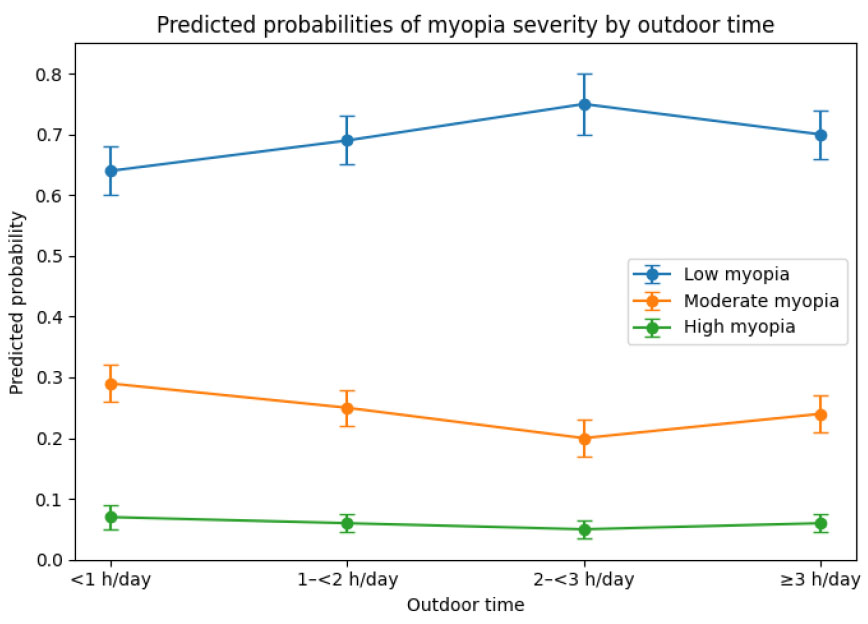
Adjusted predicted probabilities of myopia severity according to outdoor time.
Adjusted predicted probabilities of low, moderate, and high myopia across categories of daily outdoor time (<1 h/day, 1-<2 h/day, 2-<3 h/day, and ≥3 h/day). Predicted margins were estimated from an ordered logistic regression model adjusted for age, sex, geographic region, near-work behaviors, extra study time, screen exposure, outdoor activity, and family history of myopia, with robust standard errors to account for within-school clustering. Error bars represent 95% confidence intervals.
3.7. Sensitivity Analysis using Cluster-robust Logistic Regression
To evaluate the robustness of the primary findings, a sensitivity analysis was performed using multivariable logistic regression with cluster-robust (sandwich) standard errors to account for within-school clustering (Table 5). The overall pattern and magnitude of associations remained highly consistent with those observed in the primary multivariable model.
Sensitivity analysis was performed using multivariable logistic regression with cluster-robust (sandwich) standard errors to account for within-school clustering. The model was adjusted for near-work behaviors, extra study time, screen exposure, outdoor activity, and family history of myopia.
| Variable | Cluster-adjusted aOR | 95% CI |
|---|---|---|
| Near-work ≥30 cm | 0.23 | 0.19-0.28 |
| Outdoor ≥3 h/day | 0.50 | 0.41-0.60 |
| Screen ≥2 h/day | 1.42 | 1.24-1.63 |
| Extra study time >2 h/day | 1.60 | 1.30-1.97 |
| Sibling myopia | 1.80 | 1.55-2.10 |
| Parental myopia | 1.28 | 1.13-1.45 |
Maintaining a near-work distance ≥30 cm remained strongly protective against myopia compared with distances <20 cm (cluster-adjusted aOR = 0.23, 95% CI 0.19-0.28). Spending ≥3 h/day outdoors was associated with a substantially reduced risk of myopia (cluster-adjusted aOR = 0.50, 95% CI 0.41-0.60). In contrast, screen exposure ≥2 h/day (cluster-adjusted aOR = 1.42, 95% CI 1.24-1.63) and extra study time >2 h/day (cluster-adjusted aOR = 1.60, 95% CI 1.30-1.97) remained significant independent risk factors.
Sibling myopia remained a strong independent correlate of myopia (cluster-adjusted aOR = 1.80, 95% CI 1.55-2.10), with a larger effect size than parental myopia (cluster-adjusted aOR = 1.28, 95% CI 1.13-1.45). Overall, only minor changes in the adjusted odds ratios and confidence intervals were observed, while the direction and statistical significance of all associations remained unchanged, supporting the robustness of the primary findings.
Compared with the primary multivariable model (Table 3), the cluster-robust sensitivity analysis produced only minor changes in the adjusted odds ratios, with no changes in the direction or statistical significance of the observed associations.
3.8. Interaction Effects between Outdoor Time and Screen Exposure
Significant effect modification was observed between outdoor time and screen exposure (p for interaction = 0.018). The positive association between screen time ≥2 h/day and myopia was substantially weaker among children who spent ≥3 h/day outdoors compared with those spending <1 h/day outdoors (Fig. 2).
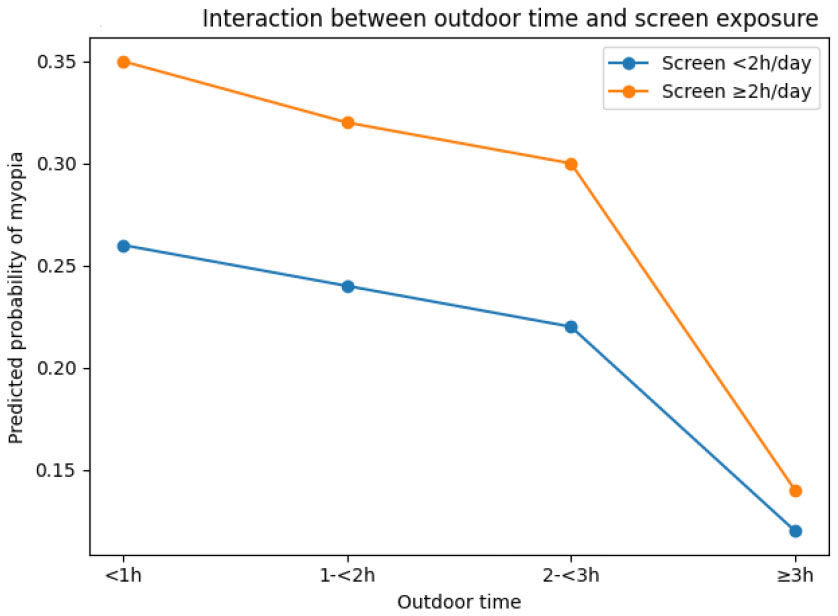
Interaction between outdoor time and screen exposure on myopia risk.
Adjusted predicted probabilities of myopia according to categories of outdoor time, stratified by daily screen exposure (<2 h/day vs ≥2 h/day). Predicted margins were estimated from a multivariable logistic regression model adjusted for age, sex, geographic region, near-work behaviors, extra study time, outdoor activity, and family history of myopia, with robust standard errors to account for within-school clustering. Error bars represent 95% confidence intervals.
Among children with <1 h/day of outdoor exposure, screen time ≥2 h/day was associated with a markedly higher risk of myopia (aOR = 1.87, 95% CI 1.58-2.21). In contrast, among children who spent ≥3 h/day outdoors, the corresponding association between prolonged screen exposure and myopia risk was substantially attenuated and no longer statistically significant (aOR = 1.12, 95% CI 0.91-1.38).
These findings indicate that higher outdoor exposure may partially buffer the adverse effect of prolonged screen time on myopia risk.
3.9. Dose-response and Threshold Effects of Key Behavioral Exposures
Evidence of a threshold effect was observed for outdoor activity. Compared with children spending <1 h/day outdoors, those spending 1-<2 h/day, 2-<3 h/day, and ≥3 h/day outdoors had progressively lower odds of myopia (aOR = 0.95, 95% CI 0.82-1.10; aOR = 0.83, 95% CI 0.68-1.02; and aOR = 0.50, 95% CI 0.41-0.60, respectively). However, a statistically significant protective association was observed only among children spending ≥3 h/day outdoors (Fig. 3A, Table 5), supporting the presence of a threshold effect rather than a strictly linear dose-response relationship.
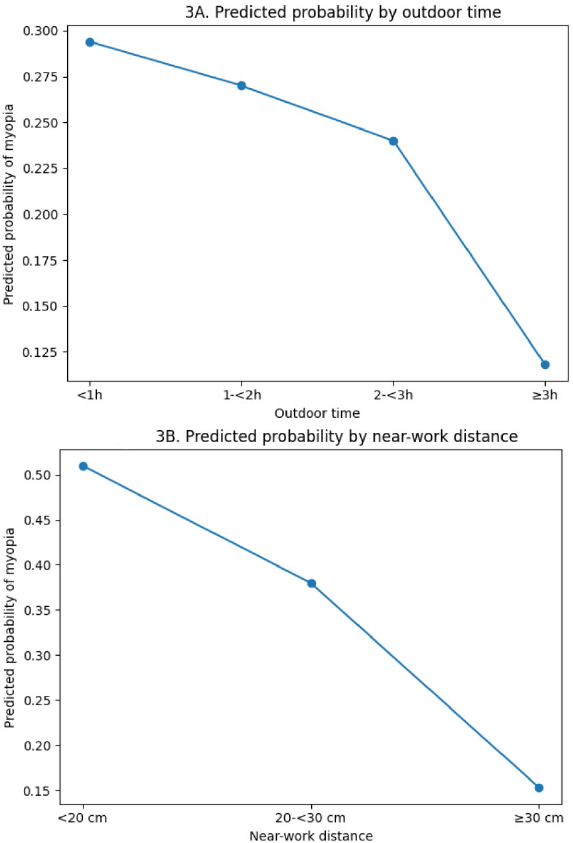
Adjusted predicted probabilities of myopia according to outdoor time and near-work distance.
(A) Adjusted predicted probabilities of myopia across categories of daily outdoor time (<1 h/day, 1-<2 h/day, 2-<3 h/day, and ≥3 h/day).
(B) Adjusted predicted probabilities of myopia across categories of near-work distance (<20 cm, 20-<30 cm, and ≥30 cm).
Predicted margins were estimated from multivariable logistic regression models adjusted for age, sex, geographic region, near-work behaviors, extra study time, screen exposure, outdoor activity, and family history of myopia, with robust standard errors to account for within-school clustering. Error bars represent 95% confidence intervals.
Similarly, near-work distance demonstrated a strong gradient (Fig. 3B, Table 5). Compared with children reading at <20 cm, those maintaining a distance of 20 -<30 cm had moderately reduced odds of myopia (aOR = 0.62, 95% CI 0.48-0.80), while those maintaining a distance ≥30 cm had the lowest risk (aOR = 0.23, 95% CI 0.19-0.28).
These findings support the presence of behavioral threshold effects, particularly for outdoor time (≥3 h/day) and near-work distance (≥30 cm), beyond which the protective effects become substantially more pronounced.
3.10. Adjusted Predicted Probabilities of Myopia Occurrence
Predicted probabilities from the multivariable models showed clear differences in myopia risk across behavioral exposure groups.
The predicted probability of myopia decreased from 29.4% (95% CI 27.6-31.2) among children spending <1 h/day outdoors to 11.8% (95% CI 10.2-13.4) among those spending ≥3 h/day outdoors (Fig. 3A). Likewise, the predicted probability of myopia was 51.0% (95% CI 48.2-53.8) among children reading at <20 cm compared with 15.3% (95% CI 14.0-16.6) among those maintaining a distance ≥30 cm (Fig. 3B).
When predicted probabilities were jointly stratified by outdoor time and screen exposure, children with <1 h/day of outdoor activity and screen time ≥2 h/day exhibited the highest predicted risk of myopia (34.6%, 95% CI 31.8-37.4), whereas those with ≥3 h/day of outdoor activity and screen time <2 h/day had the lowest predicted risk (9.7%, 95% CI 8.1-11.3) (Fig. 2).
4. DISCUSSION
This large school-based cross-sectional study provides comprehensive evidence on the prevalence, severity, and associated behavioral and familial factors of myopia among primary school children in Nghe An province, Vietnam. Several important findings emerged.
First, myopia was common among children aged 6-10 years and demonstrated a clear age-related increase.
Second, multiple modifiable behavioral factors, including near-work distance, screen exposure, outdoor activity, and extra study time, were independently associated with myopia.
Third, these behavioral factors were not only associated with myopia occurrence but also with myopia severity.
Finally, family history, particularly sibling myopia, showed a strong association with both the presence and severity of myopia.
4.1. Comparison with Previous Studies
The prevalence of myopia observed in this study is comparable to reports from other regions of Vietnam and Southeast Asia, where childhood myopia prevalence varies widely depending on age, urbanization, and educational intensity. Previous studies in Vietnam have reported prevalence estimates ranging from approximately 17% to over 40%, with higher rates consistently observed in older children and urban settings [16, 24]. Similar age-related trends have been documented in India, Hong Kong, China, Singapore, and other East Asian countries, reflecting cumulative exposure to near-work activities and reduced outdoor time as children progress through school [21, 25-28].
4.2. Near-work Behaviors and Myopia
Near-work distance emerged as one of the strongest modifiable behavioral factors associated with myopia in this study. Children who maintained a reading distance of ≥30 cm had substantially lower odds of myopia compared with those reading at distances <20 cm, even after adjustment for multiple demographic, environmental, and familial confounders. This finding aligns with the hypothesis that excessive accommodative demand and sustained hyperopic defocus during close work may promote axial elongation and the development of myopia [9, 29]. The observed dose-response pattern further underscores the importance of appropriate reading ergonomics as a potentially simple and cost-effective strategy for myopia prevention in school-aged children.
Longer extra study time was also associated with a higher risk of myopia, especially when children spent more than two hours per day on additional study after school. In this study, “extra study time” referred to learning activities outside regular classroom instruction. In Vietnam, primary school students usually spend about four hours per day in regular classes. The association between extra study time and myopia may be related to increased near-work activities after school and less time available for outdoor activities. These findings also suggest that increasing academic demands on young children may have negative effects on eye health [30].
Taken together, our results highlight the combined influence of near-work intensity, reading posture, and extended after-school study on childhood myopia. Interventions targeting modifiable near-work behaviors, such as maintaining adequate reading distance and limiting prolonged after-school study, may represent practical and actionable components of comprehensive myopia control strategies in primary school populations.
4.3. Screen Exposure and Digital Device Use
Longer screen exposure (≥2 hours per day) was also associated with a higher likelihood of myopia. Digital device use may increase myopia risk because it often involves prolonged near viewing, frequent accommodative changes, and reduced blinking. It may also replace time that children would otherwise spend outdoors. Although screen-based near work is similar to traditional reading in some ways, the interactive and extended use of digital devices may place additional visual demands, especially in younger children [31-33].
Another finding of this study was the interaction between outdoor time and screen exposure. The association between prolonged screen use and myopia weakened among children who spent ≥3 hours/day outdoors and was no longer statistically significant in this subgroup. These findings suggest that greater outdoor exposure may partly mitigate the adverse impact of prolonged screen use on myopia risk. Possible explanations include increased exposure to natural light, less sustained near work, and longer viewing distances during outdoor activities.
These results also have some public health implications. Recommendations that only focus on reducing screen time may not always be practical in the current digital environment. Encouraging children to spend more time outdoors, while also limiting excessive screen use, may be a more realistic approach to myopia prevention.
4.4. Protective Role of Outdoor Activity
Outdoor activity demonstrated a robust protective association, with the strongest effect observed among children spending ≥3 h/day outdoors, suggesting the presence of a threshold rather than a strictly linear dose-response relationship. Children who spent three or more hours per day outdoors had substantially lower odds of myopia and a reduced probability of more severe myopia. This protective association remained consistent across both binary and ordered regression analyses. Outdoor activity demonstrated a robust protective association, with the strongest effect observed among children spending ≥3 h/day outdoors, suggesting the presence of a threshold rather than a strictly linear dose-response relationship. Predicted probability analyses further showed progressively lower probabilities of moderate and high myopia with increasing outdoor exposure, supporting the protective role of outdoor activity.
Importantly, our findings further suggest the presence of a meaningful threshold effect for outdoor activity. While modest increases in outdoor exposure were associated with only limited reductions in myopia risk, a substantially stronger protective association was observed among children who spent ≥3 h/day outdoors. This pattern supports the use of concrete, behaviorally actionable cutoffs, rather than vague recommendations to “increase outdoor time”, in school- and community-based myopia prevention strategies.
Several biological mechanisms have been proposed to explain this effect, including higher ambient light intensity stimulating retinal dopamine release, which inhibits axial elongation, as well as reduced accommodative demand during distance viewing outdoors [12, 13, 29, 34]. These findings add to the growing body of evidence supporting increased outdoor time as one of the most effective and feasible population-level interventions for myopia control.
4.5. Familial Factors and the Role of Sibling Myopia
Family history of myopia was a significant risk factor in this study; however, sibling myopia demonstrated a stronger association with myopia risk and severity than parental myopia. This observation is noteworthy and may reflect the combined influence of shared genetic susceptibility and shared environmental exposures among siblings. Unlike parents and children, siblings typically experience highly similar daily routines, educational pressures, screen use patterns, and outdoor behaviors within the same household and school environment. Consequently, sibling myopia may serve as a more sensitive proxy for the combined genetic-environmental risk context in which myopia develops [35-37].
The stronger association with sibling myopia also suggests that environmental factors operating within families, such as shared study habits, parental expectations, and lifestyle patterns, may play a substantial role alongside genetic predisposition. This finding highlights the importance of family-based and household-level interventions, particularly targeting children in families where one or more siblings are already affected by myopia.
4.6. Myopia Severity and Behavioral Factors
Importantly, this study extends beyond myopia prevalence by examining factors associated with myopia severity. Ordered logistic regression analysis revealed that older age, prolonged screen exposure, prolonged extra study time, and sibling myopia were associated with increased myopia severity, whereas greater outdoor activity was associated with reduced severity. These findings suggest that modifiable behaviors may influence not only the onset but also the progression of myopia. Interventions targeting these behaviors may therefore have the potential to mitigate the development of high myopia and its associated sight-threatening complications.
Sex was included as a covariate in all multivariable analyses. No independent association between sex and either myopia occurrence or myopia severity was observed after adjustment for demographic, behavioral, and familial factors. Therefore, these findings are considered applicable to both boys and girls within the study population.
4.7. Strengths and Limitations
This study has several strengths. First, the sample size was relatively large and included children from different geographic areas within the same province. We also examined a range of behavioral and family-related factors that may be related to myopia. In addition, both binary and ordinal analyses were used, which helped provide a more detailed view of myopia occurrence and its severity.
However, several limitations should be acknowledged. First, the cross-sectional design precludes causal inference between behavioral factors and myopia. Second, behavioral information was collected through self-reported questionnaires and may therefore be subject to recall bias or reporting inaccuracies.
Another limitation is that refractive measurements were performed without cycloplegia. Non-cycloplegic refraction may overestimate myopia prevalence in younger children because of accommodative effects. However, to minimize potential misclassification, non-cycloplegic refractive measurements were verified using both autorefractometry and streak retinoscopy performed by trained ophthalmologists following standardized examination protocols. During retinoscopy, children were instructed to maintain fixation on distant targets to reduce accommodative effort. Similar approaches have been adopted in several large-scale epidemiological studies in which cycloplegic examinations were logistically challenging [38-41]. Nevertheless, residual accommodation may have resulted in some overestimation of myopia prevalence, particularly among younger children, and should be taken into account when interpreting the study findings.
Finally, although multiple demographic, behavioral, and familial factors were adjusted for in the multivariable analyses, residual confounding from unmeasured variables, such as socioeconomic status, parental education, household income, and other environmental exposures, cannot be excluded.
In addition, myopia was defined using the conventional epidemiological criterion of spherical equivalent refraction ≤ −0.50 D. Although alternative multicomponent definitions incorporating sphere and cylinder measurements have recently been proposed to reduce the potential misclassification of eyes with mixed astigmatism, this definition remains the most widely used in epidemiological studies. Furthermore, participants with astigmatism greater than 2.00 D were excluded from the present study, which may have reduced the likelihood of classifying eyes with mixed astigmatism as myopic [23, 42, 43].
CONCLUSION
This large school-based study demonstrates that myopia is common among primary school children in Nghe An province and increases markedly with age. Several behavioral factors that can be modified were associated with both the occurrence and severity of myopia. These included reading distance, extra after-school study time, screen exposure, and time spent outdoors. Children who maintained a longer reading distance and spent 3 or more hours per day outdoors had a lower risk of myopia. In contrast, longer study time and higher screen use were linked with a higher risk of myopia.
Familial factors, especially sibling myopia, were also significantly associated with myopia occurrence and severity, highlighting the combined influence of shared genetic susceptibility and shared environmental exposures. Taken together, these findings underscore the importance of early, behavior-focused, and family-based interventions that promote healthy near-work practices, adequate outdoor activity, and targeted prevention among high-risk children to reduce the burden of myopia in school-aged populations.
AUTHORS’ CONTRIBUTIONS
The authors confirm their contribution to the paper as follows: N.S.H., N.D.P., and T.T.T.: Contributed to the study conception and design. All authors participated in data collection and analysis. N.S.H. and N.D.P.: drafted the manuscript. N.S.H.: had primary responsibility for the final content. All authors reviewed the results and approved the final version of the manuscript.
LIST OF ABBREVIATIONS
| aOR | = Adjusted Odds Ratio |
| CI | = Confidence Interval |
| D | = Diopter |
| IMI | = International Myopia Institute |
| LMIC | = Low- and Middle-Income Country |
| OR | = Odds Ratio |
| RESC | = Refractive Error Study in Children |
| SAGER | = Sex and Gender Equity in Research |
| SER | = Spherical Equivalent Refraction |
| VIF | = Variance Inflation Factor |
ETHICS APPROVAL AND CONSENT TO PARTICIPATE
The study was approved by the Ethics Committee of the University of Medicine and Pharmacy at Ho Chi Minh City, Vietnam (Approval No. 523/HĐĐĐ-ĐHYD, dated March 27, 2024; IRB-VN01002/IORG0008603/FWA000 23448).
HUMAN AND ANIMAL RIGHTS
All human research procedures followed were in accordance with the ethical standards of the committee responsible for human experimentation (institutional and national), and with the Helsinki Declaration of 1975, as revised in 2013.
CONSENT FOR PUBLICATION
Written informed consent was obtained from the parents or legal guardians of all participating children before enrollment in the study.
AVAILABILITY OF DATA AND MATERIALS
The datasets generated and/or analyzed during the current study are not publicly available because they contain data from minor participants and are subject to institutional and ethical restrictions. De-identified data may be made available by the corresponding author upon reasonable request, subject to approval by the Ethics Committee of the University of Medicine and Pharmacy at Ho Chi Minh City, Vietnam (IRB-VN01002/IORG0008603/ FWA00023448) and Nghe An Eye Hospital, Vietnam.
ACKNOWLEDGEMENTS
The authors would like to thank Nghe An Eye Hospital, the Nghe An Department of Education and Training, Vietnam and the participating primary schools for their collaboration and support throughout the study.